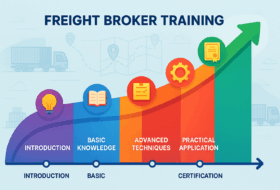

📌 TL;DR: 7 Essential Freight Agent Training Steps
- What you’ll learn: Complete freight agent training system to start earning $60K-$100K+ annually in the $400B transportation industry
- Investment required: Under $300 total startup costs with comprehensive freight agent training
- Time to launch: Complete freight agent training in 2-3 weeks and start booking loads immediately
- No licensing needed: Freight agent training teaches you to work under a broker’s authority—no FMCSA license required
- Work from home: Freight agent training prepares you for 100% remote, flexible schedule career
7 Essential Freight Agent Training Steps to Earn $100K+ in 2025
Are you ready to launch a lucrative career in the booming freight agent training industry? With the U.S. logistics sector valued at over $400 billion and growing, there’s never been a better time to pursue comprehensive freight agent training and capitalize on the unprecedented opportunities in transportation and supply chain management. This complete guide reveals the 7 essential steps that top-earning freight agents follow, including current freight industry updates, transportation trends, and proven strategies to build a six-figure income from the comfort of your home.
What is Freight Agent Training?
Freight agent training is a specialized educational program that equips aspiring logistics professionals with the knowledge, skills, and tools needed to succeed as independent freight agents. Unlike Best Online Freight Broker Training for Beginners (2025) Step-by-Step Guide that prepares you to obtain federal licensing, freight agent training focuses on sales, customer relationships, carrier coordination, and operational excellence while working under an established broker’s authority.
Quality freight agent training programs cover industry fundamentals, load booking procedures, rate negotiations, compliance requirements, shipper prospecting strategies, and the technology platforms essential for modern freight coordination. According to recent logistics news and supply chain trends, the demand for skilled freight agents continues to rise as shippers seek personalized service and relationship-based partnerships rather than purely transactional price competition.
U.S. Freight Industry Value
Top Agent Annual Earnings
Total Startup Investment
Step 1: Choose Comprehensive Freight Agent Training
The foundation of your freight agent career begins with selecting the right freight agent training program. Not all training is created equal—comprehensive programs like those offered at FreightBrokersCourse.com provide step-by-step instruction, downloadable resources, industry forms and contracts, ongoing support, and access to essential tools including shipper databases and transportation directories.
When evaluating freight agent training options, look for programs that include instruction on industry terminology, equipment types (dry van, reefer, flatbed, specialized), documentation procedures, load boards, transportation management systems (TMS), customer relationship management (CRM) software, and sales techniques specific to the freight brokerage industry. According to the U.S. Department of Transportation, understanding federal regulations and compliance requirements is critical for long-term success.
The best freight agent training courses offer self-paced online learning with chapter quizzes, certification upon completion, and lifetime access to updated materials. Most students complete comprehensive freight agent training within 2-3 weeks while maintaining their current employment, making this an ideal career transition option. With packages starting at just $99, professional freight agent training is remarkably affordable compared to traditional college programs or vocational certifications.
“Investing in quality freight agent training was the best career decision I ever made. Within 90 days of completing the course, I was earning consistent commissions and had built a portfolio of recurring shippers. The training provided everything I needed to succeed.”
— Successful freight agent, FreightBrokersCourse.com graduate
Step 2: Understand Freight Agent vs Freight Broker
A critical component of freight agent training is understanding the distinction between freight agents and freight brokers. This knowledge helps you make informed career decisions and set realistic expectations for your business model, startup costs, and income potential.
Freight Broker Requirements
Freight brokers must obtain Federal Motor Carrier Safety Administration (FMCSA) operating authority, post a $75,000 surety bond or trust fund, maintain process agents in all states where they operate, carry contingent cargo insurance, and assume full legal liability for shipments. According to FMCSA regulations, brokers are responsible for carrier vetting, compliance, collections, and bad debt. Startup costs for licensed freight brokers typically exceed $10,000-$15,000 when accounting for licensing fees, bonding, insurance, and operating capital.
Freight Agent Advantages
Freight agent training prepares you for a dramatically different business model with significantly lower barriers to entry. Freight agents work as independent contractors under a licensed broker’s authority, which eliminates bonding requirements, reduces liability exposure, and slashes startup costs to under $300. Agents focus exclusively on sales, customer service, and load coordination while the parent broker handles compliance, invoicing, collections, insurance claims, and back-office operations.
Commission splits for freight agents typically range from 60/40 to 80/20, meaning agents retain 60-80% of the gross profit margin on every load they broker. Top-performing agents who complete comprehensive freight agent training and maintain consistent prospecting activity earn $60,000-$100,000+ annually. According to recent trucking news and freight industry updates, experienced agents with established shipper relationships enjoy predictable recurring revenue and work-from-home flexibility.
Step 3: Master Freight Industry Fundamentals
Professional freight agent training provides comprehensive instruction on industry fundamentals including equipment types, freight classifications, documentation procedures, and the roles of shippers, carriers, and brokers in the supply chain.
Equipment Types and Specialization
Quality freight agent training programs teach the characteristics, applications, and rate structures for common equipment types including dry van trailers (the most common freight mode), refrigerated (reefer) trailers for temperature-controlled cargo, flatbed trailers for oversized or construction materials, and specialized equipment like tankers, car haulers, and lowboys. Understanding equipment specifications allows agents to accurately quote rates, source appropriate carriers, and serve diverse shipper needs.
Current Transportation Trends
Staying informed about transportation trends and logistics news is essential for freight agent success. October 2025 freight industry updates indicate capacity rebalancing after years of oversupply, with carrier attrition and reduced Class 8 truck orders creating a more stable market environment. Contract and spot rates are converging, signaling improved market equilibrium. The best freight agent training includes instruction on interpreting market indicators, seasonal patterns, and economic factors that influence freight rates and capacity availability.
Emerging supply chain trends reshaping the logistics landscape include digital freight marketplaces, API-based system integrations, real-time shipment tracking, blockchain documentation, and artificial intelligence for route optimization. Modern freight agent training emphasizes technology proficiency, teaching agents to leverage transportation management systems, load boards like DAT and Truckstop, and communication platforms that streamline operations and enhance customer service.
Step 4: Learn Load Booking and Operations
Operational excellence distinguishes successful freight agents from those who struggle. Comprehensive freight agent training teaches the complete shipment lifecycle from initial customer contact through delivery confirmation and invoicing.
Shipment Coordination Process
Freight agent training covers essential operational procedures including rate quoting (calculating costs, applying margins, presenting competitive pricing), carrier sourcing (evaluating safety scores, insurance verification, equipment availability), load tendering (providing detailed pickup/delivery instructions, confirming appointments), shipment tracking (proactive communication, problem resolution, delivery updates), and documentation (bill of lading, proof of delivery, rate confirmations).
Understanding compliance requirements prevents costly mistakes and builds credibility with both shippers and carriers. Quality freight agent training programs explain Department of Transportation (DOT) regulations, FMCSA safety requirements, hours of service rules, cargo insurance provisions, and documentation retention policies. Agents who demonstrate compliance knowledge earn trust and secure long-term customer relationships.
Technology and Tools
Modern freight agents rely on technology platforms that streamline operations and improve efficiency. Freight agent training includes instruction on load boards for carrier sourcing, transportation management systems (TMS) for shipment tracking and documentation, customer relationship management (CRM) systems for contact management and follow-up automation, and communication tools including email, phone systems, and instant messaging platforms. Proficiency with these technologies is essential for competitive advantage in today’s digital freight marketplace.
Step 5: Develop Sales and Marketing Skills
Since freight agents earn commission-based income, sales proficiency directly determines earning potential. The best freight agent training dedicates substantial instruction to prospecting strategies, cold calling techniques, relationship building, and consultative selling approaches.
Shipper Prospecting Strategies
Effective freight agent training teaches targeted prospecting methods including identifying ideal customer profiles (manufacturers, distributors, retailers, importers/exporters), utilizing shipper databases and industry directories, leveraging LinkedIn for B2B networking, attending trade shows and industry events, and implementing referral programs. Students learn to create compelling value propositions that differentiate their services from competitors and address specific shipper pain points.
Cold calling remains one of the most effective prospecting methods for freight agents, yet many struggle without proper training. Comprehensive freight agent training programs provide call scripts, objection handling techniques, voice mail strategies, and follow-up sequences that convert prospects into customers. Role-playing exercises and recorded call reviews help students develop confidence and refine their communication skills before making live prospecting calls.
Digital Marketing Tactics
Modern freight agent training incorporates digital marketing instruction including professional website development, search engine optimization (SEO) for local market visibility, social media marketing on LinkedIn and Facebook, email marketing campaigns for lead nurturing, and content marketing to establish thought leadership. Agents who implement multi-channel marketing strategies accelerate customer acquisition and build more sustainable businesses compared to those relying solely on cold calling.
“The sales training component was invaluable. I had zero freight experience before enrolling, but the scripts, call strategies, and marketing guidance gave me everything I needed to start booking loads within my first month. The freight agent training paid for itself within days.”
— First-year freight agent earning $6,500/month
Step 6: Choose the Right Parent Broker
One of the most critical decisions covered in freight agent training is selecting the right parent broker to partner with. This relationship determines your commission split, technology access, support quality, and overall success potential.
Broker Evaluation Criteria
Freight agent training teaches systematic evaluation of potential parent brokers based on commission structure (60/40, 70/30, or 80/20 splits), carrier network size and diversity, technology platform quality and user experience, back-office support responsiveness, payment frequency (weekly vs. monthly commissions), training and mentorship availability, company reputation and stability, and agent success stories and testimonials.
Interview multiple brokers before making commitments. Ask detailed questions about their carrier vetting procedures, claims handling processes, shipper onboarding requirements, marketing support, and agent retention rates. Established brokers with strong industry reputations provide stability and resources that facilitate agent success, while newer brokers may offer higher commission splits but less infrastructure and support.
Red Flags to Avoid
Quality freight agent training warns about problematic broker relationships including upfront fees or monthly charges (reputable brokers don’t charge agents to join), unrealistic income promises without acknowledging the work required, lack of transparency about commission calculations, poor communication or unresponsive support staff, and limited technology or outdated systems. Research potential brokers thoroughly using online reviews, Better Business Bureau ratings, and conversations with current agents before signing partnership agreements.
Step 7: Launch and Scale Your Business
The final component of comprehensive freight agent training is implementation—taking action, launching your freight agent business, and systematically scaling operations to achieve your income goals.
First 90 Days Action Plan
Freight agent training programs provide structured launch plans for your first 90 days including daily prospecting activity (minimum 50 outbound calls, 20 email outreaches), follow-up systems for tracking conversations and scheduling callbacks, rate quoting practice to build confidence and speed, carrier relationship development for capacity during peak periods, and continuous learning through industry publications and peer networking.
Set realistic expectations—most agents book their first load within 2-4 weeks and generate $500-$2,000 in first-month commissions. By month three, agents who maintain consistent activity typically earn $2,000-$5,000 as they develop recurring shipper relationships. By month six, established agents with 5-10 regular customers commonly exceed $5,000-$8,000 in monthly commission income. According to recent logistics news, agents who complete professional freight agent training and implement systematic prospecting strategies reach $100,000+ annual income within 18-24 months.
Scaling Strategies
Advanced freight agent training covers growth strategies including account-based selling to secure larger enterprise shippers, lane specialization to become the expert in specific geographic corridors, team building by recruiting sub-agents and earning residual income, and technology leverage to improve efficiency and handle higher shipment volumes. Top-earning agents focus on customer retention and expansion, recognizing that existing customers generate 3-5 times more profit than new customer acquisition.
🚀 Start Your Freight Agent Training Today
Enroll in our comprehensive freight agent training course and receive a FREE 60,000+ Shippers List to jumpstart your business!
Use Code: FREESHIP at checkout
Freight Agent Training Investment and ROI
Professional freight agent training represents an exceptional return on investment compared to traditional education or business franchises. Complete training packages range from $99-$500 depending on inclusions like physical training manuals, transportation directories, load board memberships, and ongoing mentorship. Total startup costs including training, computer, phone, internet, and basic office supplies typically remain under $300.
Compare this minimal investment to alternatives: four-year college degrees cost $40,000-$200,000+, trucking company ownership requires $100,000-$500,000+ for equipment and operating capital, and freight broker licensing demands $15,000+ for bonding, insurance, and working capital. Freight agent training delivers comparable or superior income potential with dramatically lower financial risk and faster time to profitability.
Complete Freight Agent Training
Time to First Commission
Reach $100K+ Annual Income
Current Freight Industry Updates
Staying informed about freight industry updates, transportation trends, and supply chain trends is essential for freight agent success. October 2025 logistics news indicates several positive developments for aspiring freight agents including capacity rebalancing as carrier attrition and reduced equipment orders bring supply/demand into better equilibrium, stabilizing rates with contract and spot rates converging after years of volatility, technology adoption accelerating with AI, blockchain, and digital freight marketplaces improving efficiency, and labor market shifts creating demand for remote work opportunities like freight agent careers.
According to the American Trucking Associations, the industry faces ongoing driver shortages projected to exceed 160,000 by 2030, creating opportunities for freight agents who can match available capacity with shipper demand. Recent trucking news also highlights increasing fuel costs, insurance premiums, and regulatory compliance expenses that squeeze carrier profit margins—factors that elevate the importance of skilled freight agents who negotiate fair rates and facilitate efficient operations.
Additional Training Resources
Beyond core freight agent training, successful agents invest in continuous education and professional development. Recommended resources include starting a freight brokerage company guides for agents considering broker licensing, freight broker laws and compliance training to understand regulatory requirements, and dispatcher training courses for agents who want to diversify their service offerings.
Industry publications like Transport Topics, FreightWaves, and Commercial Carrier Journal provide daily logistics news and market intelligence. Join professional associations such as the Transportation Intermediaries Association (TIA) for networking opportunities, advocacy, and advanced education. Participate in online forums, social media groups, and local freight industry meetups to exchange best practices with fellow agents and stay current on emerging transportation trends.
Freight Agent Training FAQs
Take Action on Your Freight Agent Training
The path to freight agent success starts with comprehensive freight agent training that provides both foundational knowledge and actionable implementation strategies. The 7 essential steps outlined in this guide—choosing quality training, understanding agent vs broker differences, mastering industry fundamentals, learning operational procedures, developing sales skills, selecting the right parent broker, and systematically launching your business—create a proven roadmap for achieving $100,000+ annual income in the transportation industry.
With startup costs under $300, work-from-home flexibility, no licensing requirements, and income potential exceeding traditional careers requiring expensive college degrees, freight agent training represents one of the most accessible entrepreneurial opportunities available in 2025. Recent freight industry updates and transportation trends indicate a stabilizing market with improving fundamentals, creating an ideal environment for properly trained agents to build sustainable, profitable businesses.
Don’t delay—every day you postpone freight agent training is a day of lost income opportunity in the $400+ billion freight industry. Thousands of shippers need reliable freight agents right now, and carriers are seeking quality brokers who treat them fairly and provide consistent freight opportunities. Your comprehensive freight agent training prepares you to serve both sides of this transaction and earn substantial commission income in the process.
“I researched freight agent training programs for months before enrolling. The comprehensive curriculum, lifetime access, shipper database, and ongoing support made this program the obvious choice. Six months later, I’m earning more than my previous corporate job with complete schedule flexibility and unlimited income potential.”
— Freight agent earning $9,200/month after completing training
📈 Growth + Change = Opportunity
How will YOU capitalize on the opportunities in the freight industry as a trained freight agent?
Enroll in our freight agent training course today and get a FREE Shippers List!
Use Promo Code: FREESHIP